Music Rap Time Battle
- 4.0
- Rating
- 10.00M
- Installs
- Free
- Price

 Analysis by App-foxy
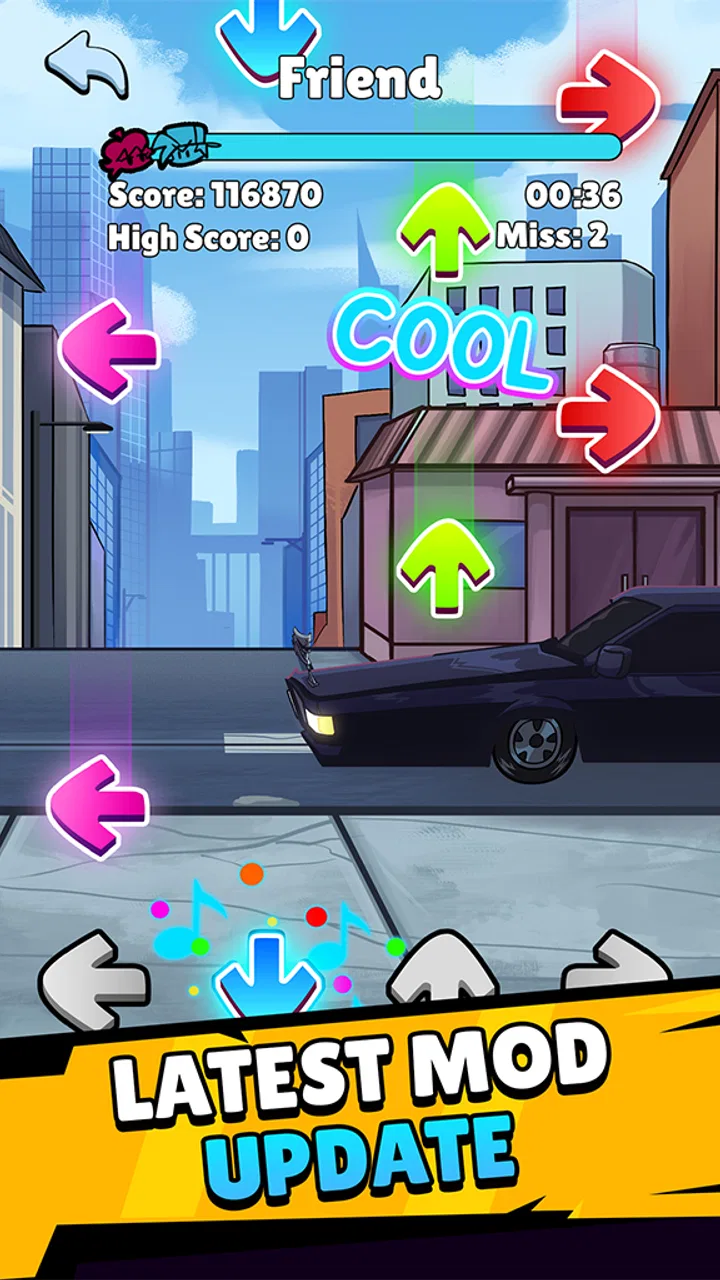
I approached Music Rap Time Battle as a quick music game rather than a full rhythm-training tool. Its central idea is easy to understand: colorful arrows arrive in time with the track, and I use my finger to hit them accurately. That simplicity makes it immediately approachable, especially when I only have a few spare minutes, but it also means the experience depends heavily on how satisfying the timing feels over repeated sessions.
Created by Unicorn Studio Official, this free game sits in the music section and is suitable for Everyone. It has attracted over ten million installs and holds a 4.0 average from around twenty-six thousand ratings, which suggests that the basic pick-up-and-play formula has found a sizeable audience. I can see why: there is no complicated setup, no long explanation before the first attempt, and the visual language is clear enough for a new player to understand quickly.
How the arrow-based music play feels in practice
The first thing I noticed is how little mental preparation the game demands. I do not need to learn a large control scheme or manage several menus before playing. The arrows provide the immediate instruction, while the music supplies the rhythm. That combination makes the game suitable for a short break, a waiting room, or a casual session when I want something more active than simply listening to a song.
You May Also Like

 AccuWeather: Weather Radar
AccuWeather Review: A Quick, Clear Forecast for Everyday Decisions
For everyday plans, the best forecast is the one you can understand quickly. AccuWeather makes rain timing, radar, and local conditions easy to act on, with a few trade-offs.

 Hill Climb Racing
Why Hill Climb Racing Still Turns Crashes Into One More Run
A tiny car, a bumpy hill and one more upgrade: Hill Climb Racing keeps resurfacing because its simple chaos makes every near-miss feel personal.

 AliExpress - Shopping App
AliExpress Makes Global Shopping Feel Personal, but Shoppers Bear the Risk
AliExpress turns a global marketplace into a pocket-sized discovery engine. Its reach is useful, its shopping loop compelling, and its trade-offs easy to miss.

 Lords Mobile: Kingdom Wars
Lords Mobile Is a Kingdom-Building Routine, Not a Quick Match
A case-by-case verdict on the building, battles, device demands, and social commitments that make Lords Mobile rewarding for some players and exhausting for others.

 PDF Scanner app - TapScanner
TapScanner Makes Paperwork Easier to Capture, Check, and Share
TapScanner makes scanning with a phone feel less like a rescue operation and more like a dependable step in getting work done. Its capture tools are useful, though not flawless.

 Block Blast!
 Shows How Much a Puzzle Game Can Leave Out
A quiet grid game shows why puzzle players increasingly value instant clarity, repeatable skill and low-pressure play—and where the genre still needs to catch up.
More From Our News Desk
View All News


The colorful presentation helps with recognition. On a small phone screen, visual contrast matters because the player has to read the next input while still watching the current one. I found that the game’s appeal comes less from deep musical analysis and more from the satisfying loop of seeing an arrow, reacting to it, and trying to stay aligned with the beat.
That also creates the first important trade-off. A simple control idea is welcoming, but it can become repetitive if the available material does not continue to challenge the player. Someone looking for a broad rhythm library, detailed song discovery, or an instrument-like experience may prefer a more established music game with a stronger emphasis on variety. This title is better understood as a focused reflex game with a musical skin than as a replacement for a serious rhythm-learning app.
For a realistic everyday example, I could play a few rounds during a short commute or while taking a break from work. I would not need to commit to a long campaign, and the finger-based controls are comfortable for brief bursts. However, I would avoid starting a difficult session while walking, cooking, or doing anything that divides my attention. The game asks for visual timing, so it works best when I can keep my eyes on the screen and my hand steady.
Starting without a heavy learning curve
The accessible design is one of its strongest qualities. A younger player can understand the arrow concept quickly, while an adult can begin without reading a long manual. The Everyone age rating also makes it a natural option for households looking for a light, non-intimidating music game. Still, age suitability does not automatically mean that every session will feel equally calm. Fast inputs can create pressure, particularly for players who become frustrated when a near miss breaks their rhythm.
I recommend treating the first sessions as practice rather than as a test of skill. Watching the movement pattern for a moment before chasing a perfect result helps me understand whether my difficulty comes from reaction speed, visual overload, or simply playing with the sound too low. That distinction matters because the best adjustment may be changing the environment rather than blaming the controls.
Sound is especially important in a game built around timing. I would play with audio enabled whenever possible, because relying only on visual movement makes the task feel less musical and more like a reaction exercise. In a noisy place, headphones may make the beat easier to follow, although I would keep the volume comfortable and remain aware of my surroundings.
Where the free model affects the decision
The game is free to download, but it includes in-app purchases priced at $1.99 per item. That is the key spending detail I would want to understand before handing the phone to a child or allowing purchases on a shared device. The individual item price is straightforward, yet the practical cost depends on what a player chooses to buy and how often those purchases become tempting during continued play.
I would begin without spending anything and first decide whether the core arrow timing remains enjoyable after several short sessions. That is a useful test for any free music game: if the basic loop is not satisfying on its own, purchasing extras is unlikely to fix the underlying problem. Conversely, if the free experience already provides enough entertainment, the purchases can remain optional from my point of view.
I would also use the device’s purchase controls before letting a child play independently. I am not assuming that every purchase is necessary or that the game is unfair because paid items exist; the confirmed pricing simply means spending is part of the product’s structure. A careful player should separate “I want more” from “I need this to play,” and avoid making that decision in the middle of a frustrating round.
Progress, pressure, and the reason players keep returning
Music games often turn a very small action into a personal challenge. I may begin by trying to complete a track, then shift toward improving accuracy, reacting faster, or avoiding the same mistake on the next attempt. That kind of self-competition can give a short game surprising staying power, even when the controls remain simple.
In this title, the pressure comes from keeping up with the arrows rather than from managing a complicated character or strategy system. That focus is useful for players who want immediate feedback, but it can also feel unforgiving if the timing window seems narrow. My advice is to look for patterns in mistakes: repeatedly missing the same direction may indicate that I am watching the wrong part of the screen, while scattered misses may point to fatigue or poor audio conditions.
Short sessions are a better fit than marathon play for this style of game. After several attempts, my reactions can become less precise even though I feel more determined to improve. Taking a break protects the fun and gives me a clearer sense of whether I am genuinely learning the rhythm or merely repeating errors. This is one of the less obvious differences between a satisfying challenge and a frustrating loop.
The game may appeal most to people who enjoy immediate goals. If I need a long narrative, character development, or a carefully structured progression system, I would look elsewhere. If I want a compact activity that turns music into finger movement, the narrow focus is an advantage rather than a weakness.
Is the experience fair to players who do not spend?
From a fairness perspective, I would judge the game in two stages. First, I would ask whether the basic play is enjoyable without buying anything. Second, I would watch whether paid options feel like conveniences or like pressure placed in front of normal progress. The presence of $1.99 items alone does not answer those questions, so I would avoid treating the purchase system as either automatically harmless or automatically problematic.
For a non-spending player, the safest approach is to establish a clear boundary before playing. I can enjoy the timing challenge, track my own improvement, and decide that optional purchases are not part of my session. That mindset is particularly helpful when a missed sequence makes me want to unlock something immediately. A moment of frustration is a poor time to make a spending decision.
For families, I would consider the game appropriate only alongside ordinary device-level purchase safeguards. The Everyone rating speaks to the general audience, not to a guarantee that every child will handle optional purchases sensibly. Parents should explain that free installation and paid items are separate things, then decide whether purchases should be blocked or require approval.
Compared with a completely paid rhythm game, this model lowers the barrier to trying the experience but introduces a budgeting question. Compared with a music streaming service, it offers interaction rather than passive listening, but it is not a substitute for discovering or controlling a broad music catalog. Compared with a rhythm-learning app, it prioritizes quick reactions and entertainment instead of structured musical instruction. Choosing between them depends on whether I want play, listening, or learning.
What I would check before committing to it
One practical question is whether the game feels comfortable on my particular phone. The minimum operating system is Android 7.0, so many older compatible devices can potentially run it, but compatibility is not the same as an equally pleasant experience. Screen size, touch responsiveness, speaker quality, and performance can all affect a timing game. I would test a few rounds before deciding that a missed input is the game’s fault.
The current version is 1.0.0.68. I mention that because version information can matter when troubleshooting or comparing experiences across devices. If the game behaves differently after an update, noting the version gives me a more useful starting point than relying on memory. I would also keep the application updated through the normal platform process when possible, while remembering that an update can change the feel of timing or presentation.
Another question is whether the music and visual pace suit my taste. A store summary can explain the arrow concept, but it cannot tell me whether I will enjoy the actual mood of repeated sessions. I would not install this expecting a realistic instrument simulator or a deep catalog-management experience. I would install it expecting colorful, finger-led rhythm play and then decide whether that loop earns a place on my phone.
Players who need accessibility options should make their decision carefully and personally. Timing games can be difficult when visual signals, touch response, or audio cues do not match individual needs. I would pay attention to whether I can comfortably distinguish the arrows and follow the beat, rather than assuming that a simple control scheme is automatically accessible to everyone.
Who will enjoy it, and who should skip it
I think this game is a good match for casual players who like music-themed challenges but do not want a large commitment. It is also a reasonable choice for someone trying to introduce a younger player to a simple rhythm concept, provided spending controls are in place. The free entry point makes experimentation easy, and the arrow mechanic can produce satisfying short sessions when the timing feels natural.
I would recommend skipping it if I were searching for music education, realistic performance practice, a large social competition scene, or a story-driven game. I would also be cautious if repeated misses quickly spoil my mood. The design puts the focus directly on reaction and timing, so there is less room to recover through strategy or exploration when a sequence becomes difficult.
It is not the right choice for every listening situation either. If I want background entertainment while my eyes are busy elsewhere, a podcast or music player is more suitable. This game needs attention. Its strength is active engagement, and that same quality becomes a limitation when I cannot safely look at the screen.
My trust verdict after weighing the trade-offs
The combination of a free starting point, a clear arrow-based idea, and a large installed audience makes Music Rap Time Battle easy to try. Its 4.0 average from around twenty-six thousand ratings gives me a useful sign that many players find value in it, though a rating cannot predict whether its particular rhythm and purchase balance will suit me. I would use the first sessions to evaluate the feel rather than treating popularity as a guarantee.
My spending verdict is cautious but fair: I would play for free first, set purchase controls on shared devices, and only consider a $1.99 item if I understood exactly what I was buying and still wanted it after the novelty had settled. That approach keeps the decision connected to enjoyment instead of pressure.
My final recommendation is for casual music-game fans who want quick finger challenges and colorful presentation. I would describe it to a friend as an easy-to-start rhythm diversion, not as a complete music platform or a substitute for learning an instrument. If that distinction matches what you want, Music Rap Time Battle is worth trying without spending money immediately. Its best quality is the immediacy of turning a beat into a simple physical response; its main risk is that the same narrow loop may not hold your attention for long.
For me, the sensible way to use it is in short, focused sessions: listen carefully, watch the arrow flow, notice the type of mistake I am making, and stop before frustration takes over. That keeps the game in its strongest lane—quick musical interaction—while avoiding expectations it was never designed to meet.
FAQs for Music Rap Time Battle
01What is Music Rap Time Battle and how does it work?
Music Rap Time Battle is an engaging app that allows users to participate in rap battles in a virtual arena. Players can choose between freestyle or pre-written battles, where they compete against others by improvising or performing scripted verses. The app offers a wide variety of beats and themes to inspire creativity.
02Is Music Rap Time Battle free to download and use?
Music Rap Time Battle is free to download on both Android and iOS platforms. While the basic features are available at no cost, the app offers in-app purchases for additional content such as exclusive beats, themes, and advanced battle modes, enhancing the overall experience for dedicated users.
03What are the system requirements for Music Rap Time Battle?
To ensure smooth performance, Music Rap Time Battle requires Android version 5.0 or later and iOS version 11.0 or later. The app is optimized for both smartphones and tablets, but it's recommended to have at least 2GB of RAM and a stable internet connection for seamless gameplay.
04Does Music Rap Time Battle support multiplayer battles?
Yes, Music Rap Time Battle supports multiplayer battles, allowing users to compete with friends or other players worldwide. The app features a matchmaking system that pairs users based on their skill levels, ensuring fair and exciting competitions. Players can also join tournaments to test their skills on a larger stage.
05How can I improve my skills in Music Rap Time Battle?
Improving your skills in Music Rap Time Battle involves practicing regularly and exploring various styles and themes. The app provides tutorials and tips to help new users get started. Engaging with the community, participating in battles frequently, and analyzing past performances can also contribute to better skill development.
Pros
- Engaging freestyle rap challenges.
- User-friendly interface.
- Regular updates with new content.
- Social features for community interaction.
- Offline mode available.
Cons
- Limited beat selection.
- Occasional app crashes.
- In-app purchases can be pricey.
- Requires stable internet for online features.
- Ads can be intrusive.

Music Rap Time Battle
Gallery